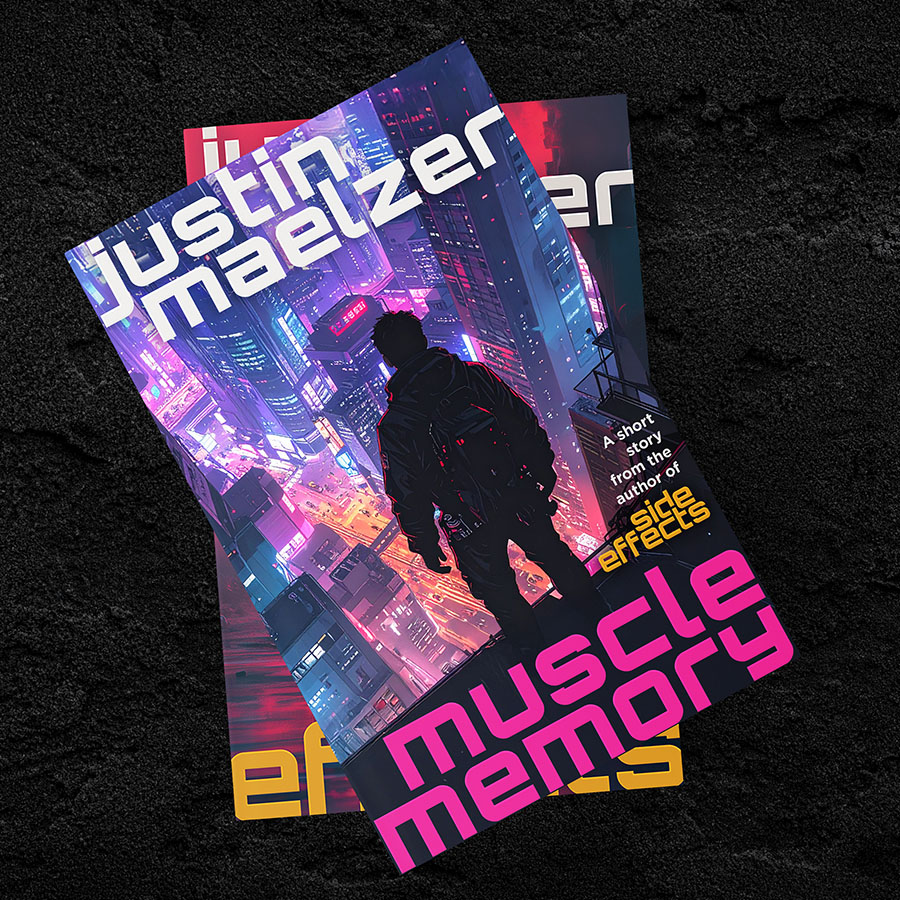
A science fiction short story from the author of Side Effects
I am a blank asset.
After years of physical training and cerebral surgery, I can take on the skills of others through memory grafts.
My mission: an audacious heist on the sixty-seventh floor of a Seoul skyscraper.
The grafts give me what I need; the instincts of a free climber, the reflexes of a martial artist, the logic of a hacker. But they come with baggage: guilt, love, resentment, lives I never lived. As I carry out the mission, I am haunted by pasts that were never mine.
What kind of person would sell their memories?
What kind of person would overwrite their own memories to use them?
Muscle Memory is a 12,500-word standalone short story in a similar universe to Side Effects, exploring the boundaries of memory, manipulation, and identity.
Where to buy Muscle Memory
Muscle Memory is out now on Amazon Kindle

Also availasble as a 75-minute audiobook on Audible

More formats and platforms will be launched soon.

About the Author
Justin Maelzer was born in Johannesburg in 1974 and grew up in the West of England. He studied Marine and Freshwater Biology at Queen Mary, University of London, and now works as a graphic designer. In his spare time, he plays guitar, writes and records music, and runs long distances. Side Effects is his first published novel.
Q&A with Justin Maelzer
Where did the inspiration for Muscle Memory come from?
It’s funny how a single line can spawn a whole story. I was watching Johnny Mnemonic, the film adaptation of William Gibson’s short story. There’s a line where Keanu Reeves says, “I want my memories back.” I instantly thought, “What if you didn’t want your own memories back?” That idea sent me down a path, and the story grew from there.
A lot of writers would be unwilling to admit such overt influences on their work. Why be so open about it?
I think we all do it, so why not be candid? That line was really just a jumping-off point, and my story has little else to do with the film. But I’m happy to acknowledge Gibson’s influence.
Is Muscle Memory a spin-off from your novel Side Effects?
No. They are both completely stand-alone stories. However, they are both set in a near future and cover similar themes, especially the idea of memories impinging on the present. If you enjoyed one of them, I'm confident you'll enjoy the other.
The story is set in Seoul. You’re based in the UK. Why choose that setting, and did you travel there for research?
I’ve never been to Seoul — in this case, I’m an armchair researcher. But I wanted to set the story there for a few reasons. First, to bring a different texture into my writing. I have no interest in setting all my work in the same place. Second, and more importantly, I liked the idea of a Westerner taking on the memories of someone from a different culture. It raises interesting questions about identity and cultural memory. It’s not a theme I hammer, but it’s there.
And did you research free climbing and martial arts as well?
Again, this was armchair research. The free climbing elements come from the documentary Free Solo about Alex Honnold — a fantastic film. I went on a bit of a climbing deep-dive afterward. The hacking aspects draw on the book Fancy Bear Goes Phishing by Scott J. Shapiro, which I also recommend. When I first explored these topics, it wasn’t with the intention to write about them, but that’s one of the great things about creating — you get to pull from all the things you’ve absorbed along the way.
At 12,500 words, this is a novelette, but it still packs in a lot — multiple lives, an action-packed heist, and plot twists. Did you ever consider expanding it into a novel?
No. I believe every story has its natural length, and I write to that. Expanding it would have required adding characters, sub-plots, and relationships that weren’t necessary. Also, the protagonist doesn’t fully have his own personality due to the nature of the story, and I don’t think that would sustain a full novel. I could have added a few thousand words with more exposition or longer set pieces, but I like how lean the writing is in Muscle Memory. I keep exposition to a minimum and trust the reader to follow. I like my prose to work for a living.
You’ve also created an audiobook and narrated it yourself. How was that experience?
This is my first audiobook, so I thought I’d start with a shorter project. It runs about 75 minutes. It’s hard work — a lot of takes, a lot of editing — but I’ve recorded music for years, so I’m comfortable in a home studio. I’m very pleased with the final result.
Do you think Side Effects will get the audiobook treatment?
We’ll see how this one goes. If people respond well to it, then yes — I’d like to record Side Effects too.
Finally, what do you hope readers get from Muscle Memory?
As with all my work, I hope readers feel it was worth their time. It’s designed to be read in one sitting, it rewards an attentive reader, and I think it can stand up to a re-read as well.



Back to Books